Ultralight Backpacking Tent Guide: What Makes a Tent 'Ultralight' — and Which to Buy (2026)
As an Amazon Associate I earn from qualifying purchases. Prices and availability are accurate as of the date/time indicated and are subject to change.
🔍 How this guide was put together (Editorial Standards)
This guide compares options using published manufacturer specifications, patterns in publicly visible owner reviews, and reputable expert sources. We do not operate a physical testing lab; see our how-we-research page for details.
EDITOR'S PICKS
Top Picks
TOP PICK

RUNNER-UP


📑 Table of contents
Walk into “ultralight tents” and the first shock is the price: legit cottage brands charge $500–800 for a two-person shelter under 2 lb. The second shock is the number of asterisks — “ultralight” is a marketing word, not a spec with a threshold. Understanding what actually makes a tent light, and what each ounce costs you in comfort, weather protection, and money, lets you buy the tent that’s light enough for your trips without overpaying for grams you won’t feel.
What “ultralight” actually means
There’s no ISO for it. In practice, the community shorthand:
| Class | Trail weight (2P tent) | Feel on trail |
|---|---|---|
| Standard backpacking | 4–6 lb | Comfortable, forgiving, easy pitch |
| Lightweight | 3–4 lb | Good all-arounder |
| Ultralight | 1.5–3 lb | Weight-obsessed choice |
| SUL / super-ultralight | Under 1.5 lb | Thru-hiker / gram-counter only |
The dividing line most people mean when they say “ultralight” is around 2 lb for a 2P tent. That’s the number to compare against.
How they get light
Manufacturers cut weight from four places, and each cut has a cost:
- Fabric weight (denier) — 15D silnylon or 7D Dyneema is much lighter than 30D standard fabric. Trade-off: less puncture-resistance, shorter lifespan under abrasion, and Dyneema (DCF) is expensive.
- Pole design — carbon fiber poles save ~30% vs aluminum. Trade-off: less flex-forgiving in wind, expensive, breakage is catastrophic.
- Non-freestanding design — tents that use trekking poles as tent poles save the weight of tent poles entirely. Trade-off: you must carry trekking poles (fine if you already do), pitch requires taut guy-outs (harder in soft ground/rocks).
- Single-wall construction — no inner-tent, just the fly. Trade-off: condensation inside unless ventilation is very good; less bug protection.
The lightest tents on the market use all four: 7D DCF fabric, no poles (trekking-pole supported), single-wall. That’s how they hit sub-1.5 lb — and cost $600+.
What weight is right for you?
Match trip length and conditions, not fashion:
- Weekend car-camping crossover, 1–3 nights: 3–5 lb tent is fine. You’ll barely feel the extra pound over 10 miles, and it’ll last a decade.
- Multi-day trips (4–7 days), varied terrain: 2.5–3.5 lb — the “lightweight” band. Best balance of comfort + weight for most backpackers.
- Thru-hike (weeks/months on trail): under 2 lb starts to matter — save half a pound every day for 100 days and it’s real cumulative fatigue.
- Winter or high wind: heavier freestanding tent, period. Ultralight fabrics tear in storms; ultralight non-freestanding pitches badly on snow or hardpack.
How much does the sleep system add?
The tent’s weight is only part of the “sleep system” total (bag + pad + tent = together). An ultralight tent under a heavy synthetic bag doesn’t actually save much. See our sleep system guide for the whole picture and our sleeping bag temperature ratings for the bag side.
Freestanding vs trekking-pole tents
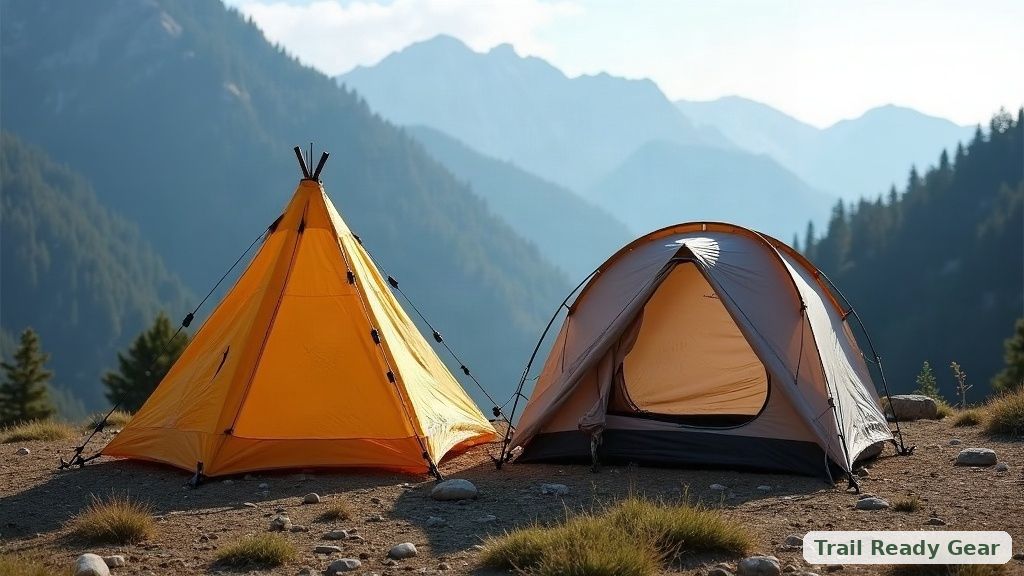
Freestanding = holds itself up with its own poles, no stakes required (though you’ll stake it anyway for wind). Pros: pitches on any surface (rock, snow, wood platform), easier for beginners, more forgiving in wind. Cons: heavier.
Trekking-pole tents = uses your hiking poles as tent structure. Pros: saves the weight of tent poles (often 0.5–1 lb). Cons: requires taut stakeouts to hold shape (soft ground = sagging tent), no pitch without your poles (broken pole = broken tent). Best if you already hike with poles.
For a first backpacking tent, freestanding wins on forgivingness — see our how to choose a backpacking tent for the fuller matching guide.
Where the money really goes
- $150–250: entry lightweight (3–4 lb) — good for beginners
- $300–500: quality lightweight (2.5–3 lb), aluminum poles, silnylon
- $500–800: ultralight (1.5–2.5 lb), DCF or thin silnylon, trekking-pole options
- $800+: SUL specialty, cottage-brand DCF
The $150–500 band is where most backpackers should shop. Save $500 on your first tent and put it toward a good pack or bag; you can always upgrade the tent later.
Care matters more when it’s light
Ultralight fabrics reward gentle handling and punish rough use. Pitch on a clean footprint, keep boots away from the floor, don’t drag it over rocks. Storage matters too — see our wash and store a sleeping bag guide which applies to tent fabrics too (compressed storage kills water-repellent coatings). And starting out with the right kit is the topic of our backpacking checklist for beginners.
📚 Related In-Depth Analysis
- Compare findings with our guide on Ultralight Backpacking Water Filter.
- Compare findings with our guide on How To Choose A Backpacking Tent.
📚 Related In-Depth Analysis
- Compare findings with our guide on Best Budget Backpacking Sleeping Bags.
- Compare findings with our guide on Hiking Water Filter Vs Purifier.
🔧 Interactive Planning Tool
Need exact measurements for your setup? Use our Trail Water Weight & Filter Planning Engine to Estimate trail water carry weight and flow rate requirements per mileage.
The bottom line
“Ultralight” means under ~2 lb for a 2P tent, achieved by trading fabric thickness, pole material, freestanding design, or single-wall for grams. It matters most for long-mileage trips — for weekend trips, a 3–4 lb lightweight tent gives you the same sleep for a third of the money and more storm-worthiness. Buy for your longest realistic trip, not the trip you might do someday. Save ounces where you’ll feel them; skip the gram-counting where you won’t.